Tudor Tuesday: Mark Smeaton - The Musician Who Confessed
The Men Accused, Part I
History has a funny way of remembering people.
Sometimes you become famous because you conquered a kingdom.
Sometimes because you married a king.
And sometimes because, in the most catastrophic few weeks of your life, you said something that would help send a queen to the scaffold.
Meet Mark Smeaton.
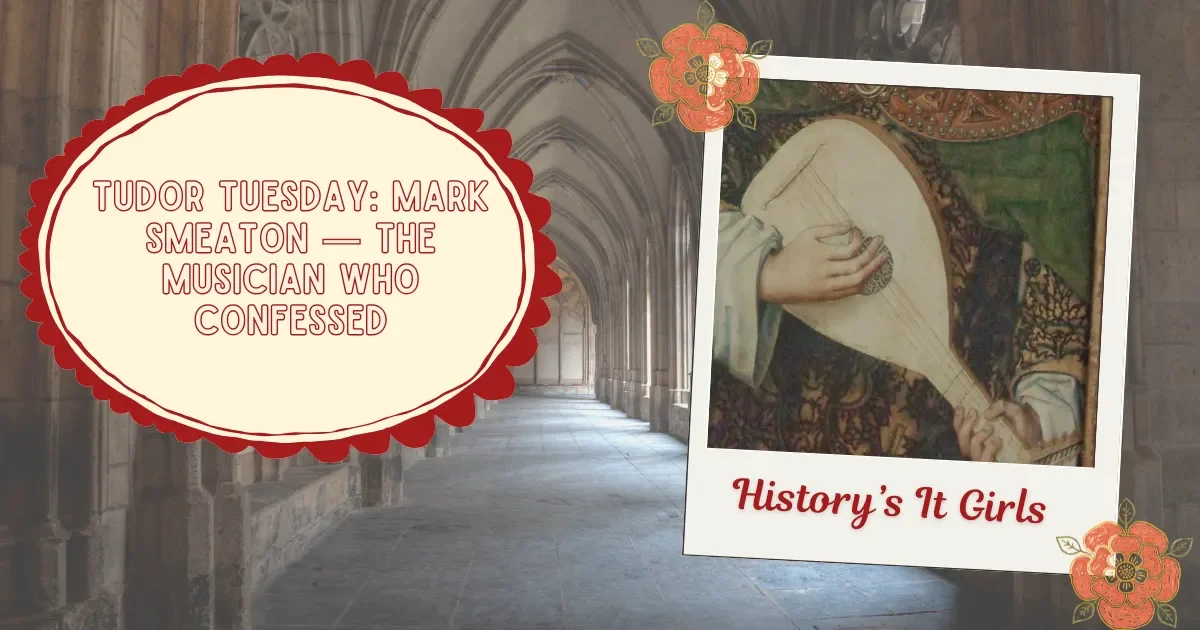
If you have read anything about the fall of Anne Boleyn, you have probably encountered his name. He was the musician. The low-born courtier. The man who confessed to sleeping with the queen.
His confession would become one of the most important pieces of evidence in the case against Anne.
But there is a problem.
We don’t actually know exactly what happened. And the more closely we look at Smeaton’s life, the more complicated his story becomes. Because before Mark Smeaton became the first man accused, he was something else entirely:
A talented young man who had managed to climb remarkably high in the glittering, dangerous world of the Tudor court.
From Obscurity to the Tudor Court
We know surprisingly little about Mark Smeaton’s early life.
He was not born into one of England’s great aristocratic families. He was not a nobleman. He did not possess the political connections of men like Henry Norris or William Brereton.
He appears to have come from a much humbler background. And yet, somehow, Smeaton found his way into the royal household.
His talent was music.
At Henry VIII’s court, that mattered.
The Tudor court was a place of spectacle. Music accompanied meals, celebrations, ceremonies, religious services, dances, and royal entertainments. A talented musician could gain access to rooms and people that would otherwise have been completely inaccessible.
Smeaton apparently had considerable ability.
He became a singer and musician in the king’s household, performing for Henry VIII and the court.
And this is where his story becomes particularly interesting.
Because Mark Smeaton was a commoner living in a world dominated by aristocrats.
He had entered a social environment where birth mattered enormously and yet his talent had given him access.
He had managed to move upward.
And Tudor England was full of people trying to do exactly that.
The Boy Who Got Too Close to the Queen?
By the 1530s, Smeaton was no longer simply an anonymous musician.
He was part of the royal household. And according to contemporary sources, he had attracted the attention of Anne Boleyn.
This is where history becomes frustrating.
Later accounts portray Smeaton as having an intimate relationship with the queen. But the surviving evidence is far less straightforward than the sensational version of the story suggests.
We know that Smeaton had some degree of access to Anne.
We know that he was around the court.
And we know that, eventually, he would be accused of having sexual relations with her.
But being in the queen’s presence was not the same thing as having an affair with her.
That distinction matters.
Especially when the punishment for adultery with a queen was death.
And Then Came April 1536
By 1536, Anne Boleyn’s position had become increasingly precarious.
She had spent years fighting to become queen.
Now she was queen.
But she had not produced the son Henry desperately wanted.
Her relationship with the king had deteriorated. And Henry had begun turning his attention toward another woman: Jane Seymour.
The political situation was becoming dangerous.
Then, on April 30, 1536, a musician named Mark Smeaton was arrested. The circumstances surrounding his arrest remain one of the most debated parts of the entire case. According to later accounts, Smeaton was taken to Thomas Cromwell’s house. And there, something happened that would change everything.
The Confession
Smeaton confessed.
That single fact has followed him through history.
According to contemporary reports, he admitted having sexual relations with Queen Anne. The precise circumstances of his confession are debated, particularly because historians have long questioned whether he was tortured.
The popular version of the story often says that Cromwell tortured Smeaton until he confessed. But there is an important distinction between what we know and what later historians have assumed.
There is no surviving contemporary record definitively proving that Smeaton was tortured. That does not mean coercion did not occur. It means we need to be careful about turning a possibility into a fact.
What we do know is that Smeaton was interrogated and that he confessed. And his confession was devastating. Because suddenly, the crown had something it desperately needed: A confession connecting Anne Boleyn to adultery.
But There Was a Problem
Smeaton’s confession did not exist in isolation. The investigators began building a case around him.
Other men were arrested.
Henry Norris.
Francis Weston.
William Brereton.
And eventually Anne’s own brother, George Boleyn.
The accusations became increasingly elaborate. Anne was alleged to have had sexual relationships with multiple men. And the most shocking allegation of all eventually emerged: That she had committed incest with George.
But here’s where Smeaton becomes especially important. His confession helped establish the narrative. He was not simply accused. He admitted guilt.
And that gave the crown something its other accusations did not initially possess.
A confession.
Why Would He Confess?
This is perhaps the most haunting question surrounding Mark Smeaton.
Why?
Why would a man confess to sleeping with the queen when he knew that adultery with the queen could mean death?
There are several possibilities.
Perhaps he was guilty.
Perhaps he was frightened.
Perhaps he believed confession might save his life.
Perhaps he was threatened or coerced.
Perhaps he was promised something.
Or perhaps some combination of these possibilities occurred.
We simply don’t know.
And that uncertainty is one of the reasons Smeaton’s story remains so fascinating.
The Tudor court was not a modern courtroom. This was a world where interrogation could be brutal, royal authority was overwhelming, and the consequences of displeasing the king could be fatal.
Smeaton was also socially vulnerable. He did not have the powerful family connections enjoyed by some of the other men accused.
He was not a nobleman surrounded by influential relatives.
He was a talented commoner who had risen through the royal household.
And suddenly, the full power of the Tudor state was pointed directly at him.
The Strange Case of the King’s Musician
There is another reason Smeaton’s story matters.
His presence among the accused tells us something about how Tudor power worked.
The men eventually accused alongside Anne came from very different backgrounds.
Henry Norris was one of Henry’s most trusted servants.
Francis Weston was a young courtier.
William Brereton was an influential administrator.
George Boleyn was a nobleman and Anne’s brother.
And then there was Mark Smeaton.
A musician.
A commoner.
Someone who had climbed into the orbit of royalty because he possessed a talent the court valued.
His story demonstrates just how fluid-and dangerous-the Tudor court could be.
You could rise quickly.
You could gain access.
You could become fashionable.
You could become noticed.
But you could also fall just as quickly.
And once royal favor disappeared, your previous success might offer very little protection.
The Trial
Smeaton did not stand trial with Anne.
He was tried alongside the other men accused of having sexual relationships with her.
The prosecution’s case rested heavily on the idea that Anne had committed adultery with multiple men and had even conspired against the king.
The accusations were extraordinary. But the legal environment was extraordinary too.
The crown was determined to establish Anne’s guilt.
And Smeaton’s confession became an important part of that effort.
The court found him guilty. His punishment was death.
There would be no pardon.
No dramatic last-minute rescue.
No return to royal favor.
On May 17, 1536, Mark Smeaton was executed at Tyburn.
He was the first of the five men accused alongside Anne to die.
He was followed by Henry Norris, Francis Weston, William Brereton, and George Boleyn.
Anne herself would be executed two days later.
The Man Who Confessed
And here is where Mark Smeaton’s story becomes particularly tragic.
For centuries, historians and storytellers have often reduced him to one sentence:
Smeaton confessed. But a confession is not necessarily the same thing as truth.
And it certainly does not tell us everything about the person who made it.
Smeaton was a musician who had achieved something remarkable for a man of his social background.
He had entered the household of the most powerful king in England.
He had performed before royalty.
He had become part of the Tudor court.
And then, almost overnight, his entire identity was rewritten.
He became:
The man who slept with the queen.
The man who confessed.
The man whose confession helped condemn Anne Boleyn.
And finally:
The man who died for it.
Was Mark Smeaton Guilty?
This is where we have to resist the temptation to give history a neat ending.
There is no definitive evidence that allows us to confidently say that Smeaton and Anne were lovers.
There is also no way to prove with absolute certainty that Smeaton’s confession was entirely fabricated. The evidence is incomplete. The circumstances were extraordinary. And the surviving sources were produced within a political environment where the king’s wishes mattered enormously.
What we can say is that Smeaton’s confession became politically useful.
It helped transform suspicion into something resembling a prosecutable case.
It gave the crown a confession.
And once the machinery of accusation began moving, there was very little anyone could do to stop it.
The Tragedy of Being the First
Of all the men accused alongside Anne, Smeaton may be the easiest to dismiss.
He wasn’t a powerful lord.
He wasn’t the queen’s brother.
He wasn’t the king’s closest friend.
He was simply a musician.
But perhaps that is exactly why his story deserves to be told first.
Because Mark Smeaton reminds us that the Tudor court was not simply a world of kings and queens.
It was filled with people trying to survive around them.
People who served them.
Entertained them.
Advised them.
Loved them.
Feared them.
And sometimes became casualties of their decisions.
Smeaton had risen farther than a man of his birth might reasonably have expected. But in the end, his proximity to power became his undoing.
The History It Girl Verdict
So, was Mark Smeaton guilty?
We don’t know.
Did he confess?
Yes.
Was his confession important to the case against Anne?
Absolutely.
Do we have definitive evidence proving that he and Anne were lovers?
No.
Was he tortured?
That is often repeated, but the surviving contemporary evidence does not definitively establish it.
And perhaps the most important question:
Did Mark Smeaton understand what was happening when he confessed?
We can only imagine.
But within days, the musician who had entertained the Tudor court was dead.
And the queen he was accused of sleeping with was about to follow him to the scaffold.
Before He Was “The Accused”
Mark Smeaton was not born a traitor. He was not born a conspirator. He was not born the villain of Anne Boleyn’s story. He was a musician who made his way into one of the most powerful households in Europe. And somewhere along the way, he found himself standing far too close to a queen whose marriage was collapsing.
That is the tragedy of The Men Accused.
We know how their stories ended.
But we rarely stop to ask how they began.
Next Tudor Tuesday, we’ll meet a very different man:
Sir Henry Norris.
He wasn’t a musician.
He wasn’t a social climber.
He wasn’t an outsider.
He was one of Henry VIII’s most trusted servants-and, according to contemporary accounts, a man who refused to confess even when the king himself allegedly offered him a chance to save his life.
And that makes his story even more complicated.
Because if Mark Smeaton was the man who confessed, Henry Norris became the man who wouldn’t.
A Note on the Sources
One of the most persistent stories about Mark Smeaton is that Thomas Cromwell tortured him until he confessed to having an affair with Anne Boleyn. The story appears in the later Spanish Chronicle, but the evidence is not conclusive. George Constantine reported that he had heard Smeaton had been racked, while the French diplomat Lancelot de Carles reported that Smeaton confessed without being tortured. Because these accounts conflict, historians continue to debate what happened during Smeaton’s interrogation.
For that reason, this article refers to Smeaton’s interrogation and confession, rather than stating as fact that he was tortured.
The surviving evidence does not allow us to know with certainty whether Smeaton’s confession was truthful, coerced, or somewhere in between.
Sources & Further Reading
Primary Sources
Letters and Papers, Foreign and Domestic, of the Reign of Henry VIII
This is one of the most important source collections for the entire Anne Boleyn crisis. It contains diplomatic correspondence, government papers, examinations, reports, and other material surrounding the events of 1536. The National Archives explains that Letters and Papers is a primary way of accessing surviving Henry VIII-era documents.
The National Archives: Letters and Papers of Henry VIII research guideLancelot de Carles, “The Fall of Anne Boleyn” / account of the events of 1536
De Carles was secretary to the French ambassador and produced an important contemporary account. His report is particularly useful when examining the question of whether Smeaton was tortured, because his version differs from the later Spanish Chronicle.George Constantine’s account
Constantine was a servant of Henry Norris and later reported that there were rumors Smeaton had been racked. His wording is important precisely because it demonstrates the uncertainty surrounding the torture story rather than proving that torture occurred.The Spanish Chronicle
The Chronicle of King Henry VIII of England, written by an unknown Spanish author, contains the famous account of Smeaton allegedly being tortured by Cromwell. It is fascinating—but should be treated cautiously. Later historians have noted that some of its stories are highly questionable.Charles Wriothesley’s Chronicle
Wriothesley was a contemporary chronicler whose work is valuable for reconstructing events during Henry VIII’s reign, including the executions in May 1536. A digitized edition is available through Internet Archive.
Scholarly & Academic Further Reading
Eric Ives, The Life and Death of Anne Boleyn
If you’re going to use one major scholarly work as a foundation for this series, Ives is essential. His reconstruction of Anne’s fall and the political circumstances surrounding the trials is especially useful for understanding why the accusations need to be studied within the larger context of Henry VIII’s court.
Retha Warnicke, The Rise and Fall of Anne Boleyn: Family Politics at the Court of Henry VIII
Warnicke is particularly useful because she challenges some traditional interpretations of Anne’s fall and examines the political and social context surrounding the accusations. Her work is excellent for your broader series because you’re interested in the men as individuals rather than simply treating them as accessories to Anne’s story.
Alison Weir, The Lady in the Tower: The Fall of Anne Boleyn
This is a very accessible detailed examination of the final weeks of Anne’s life. Weir also discusses Smeaton’s confession and the competing accounts of what happened during his interrogation. Her treatment is particularly helpful for comparing the Spanish Chronicle with other contemporary evidence.
Alison Weir, The Six Wives of Henry VIII
A broader work, but useful for establishing Henry’s relationship with Anne, Jane Seymour, and the political circumstances leading into 1536.
G. W. Bernard, Anne Boleyn: Fatal Attractions
Worth reading alongside Ives and Warnicke because Bernard takes a much more skeptical position regarding Anne’s innocence. This makes it especially useful for your series: you can show readers where historians genuinely disagree rather than presenting one interpretation as settled fact.
Accessible Online Reading
HistoryExtra — “Mark Smeaton: Was He Guilty?” by Lauren Mackay
This is probably the best accessible modern article specifically on Smeaton. Mackay emphasizes just how little we actually know about his life and discusses the competing interpretations of his confession.
Read Lauren Mackay’s HistoryExtra article on Mark Smeaton
TudorHistory.org — Mark Smeaton
A useful quick reference for the basic chronology of Smeaton’s life and execution.
TudorHistory.org: Mark Smeaton
The Anne Boleyn Files — Mark Smeaton articles
These are useful for following the chronology of April–May 1536 and, importantly, for seeing the different source traditions surrounding Smeaton’s confession and alleged torture. I would use these as supplementary reading rather than as your primary scholarly foundation.
The Anne Boleyn Files: Mark Smeaton and his interrogation